


Electrification of Catalytic Methane Decomposition to Hydrogen and Nanostructured Carbonaceous Materials
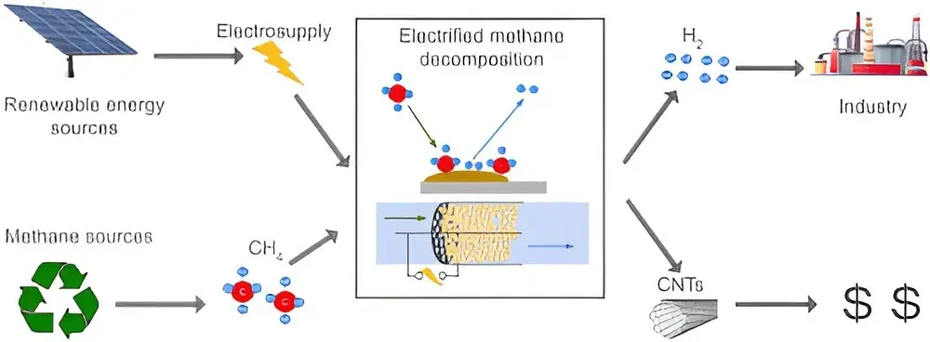
Slovenian researchers electrify catalytic methane decomposition, producing CO2-free hydrogen and high-value nanocarbons.
• Electrified CMD could economically transform hydrogen production, offering scalable, zero-emission solutions for industrial sectors.
Electrified catalytic methane decomposition (CMD) is emerging as a disruptive, carbon-free hydrogen production technology, according to groundbreaking research led by Slovenian scientists from the National Institute of Chemistry. Sergey Girshevich, David Bajec, Stanislav Yakushkin, Janvit Teržan, and Blaž Likozar have developed a novel CMD method employing plasma, microwave, and induction heating powered entirely by renewable energy. Their findings, detailed in the International Journal of Hydrogen Energy, demonstrate methane's clean split into hydrogen gas and high-value nanostructured carbon without emitting CO2, addressing industrial decarbonization challenges directly.
The innovative method optimizes energy delivery by targeting heat precisely within the reaction zone, significantly improving efficiency compared to traditional methane reforming. Key advantages include pure hydrogen production suitable for direct fuel cell use, eliminating additional purification steps, and generating commercially attractive byproducts such as carbon nanotubes and graphene. This economic incentive substantially enhances CMD's viability, creating new revenue streams to offset hydrogen production costs, particularly beneficial for regions with surplus renewable electricity.
Historically, CMD faced barriers like catalyst deactivation and inefficient carbon handling, but recent advances in nanomaterials, reactor designs, and electrification techniques have revitalized interest. The Slovenian team's approach integrates these advances, showcasing pilot-ready scalability. They're currently developing reactors capable of processing methane at scale, employing improved catalyst designs resistant to carbon buildup, and advanced digital monitoring systems for optimal reactor performance.
From an environmental perspective, electrified CMD dramatically reduces greenhouse gas emissions compared to traditional steam methane reforming (SMR), provided renewable energy is utilized. It positions itself strategically as "turquoise hydrogen," bridging grey, blue, and green hydrogen methodologies. As global hydrogen demand is projected to triple by 2030, electrified CMD presents a crucial complementary technology, especially suited for hard-to-abate industries like steelmaking, chemicals, and heavy transport that benefit from both hydrogen purity and valuable carbon derivatives.
Despite promising results, the technology still faces hurdles, including extending catalyst lifespan, developing continuous carbon harvesting mechanisms, and securing techno-economic validation through comprehensive piloting. Addressing these challenges requires collaboration among researchers, technology developers, and end-users to refine reactor designs, scale catalyst production, and establish robust supply chains for nanocarbon byproducts. As electrified CMD progresses towards industrial application, it holds significant promise as a cornerstone technology for sustainable hydrogen infrastructure and advanced materials manufacturing, substantially advancing global decarbonization efforts.
Electrified Catalytic Methane Decomposition: Hydrogen and Nanocarbo
Electrified Catalytic Methane Decomposition: Hydrogen and Nanocarbo - Fuelcellsworks
Slovenian researchers develop a novel, CO2-free method for producing hydrogen and high-value nanocarbons using electrified catalytic methane decomposition.
fuelcellsworks.com
'New Energy' 카테고리의 다른 글
| Horizon to install 10MW AEM electrolyser system at Chinese steel plant (0) | 2025.08.05 |
|---|---|
| World-First 5MW AEM Electrolyser to Deliver Cheaper Green Hydrogen, to Be Deployed End 2025 by Horizon (0) | 2025.08.05 |
| 旭化成、フィンランドの水素プロジェクトにコンテナ型アルカリ水電解システムAqualyzer™-C3を供給 (0) | 2025.08.04 |
| 水素貯蔵量20%増、FDKが「合金」新開発 (0) | 2025.08.04 |
| 東北大学など、希少金属を使わない水電解システム 水素製造コスト低減 (0) | 2025.08.01 |