
블로그 이미지
Morning lark

카테고리

분류 전체보기 (2262)
Fuel Cell (898)
New Energy (1211)
Energy Storage (6)
New Biz Item (2)
Total
Today
Yesterday

달력

« » 2025.12
1 2 3 4 5 6
7 8 9 10 11 12 13
14 15 16 17 18 19 20
21 22 23 24 25 26 27
28 29 30 31

공지사항

최근에 올라온 글

Simple teflon coating boosts hydrogen production efficiency by 40%


A common non-stick coating used in cookware has been shown to enhance hydrogen production efficiency in water electrolyzers by approximately 40%. The key innovation involves applying a specialized coating to critical components to prevent hydrogen bubbles from adhering, thereby enabling smoother hydrogen release.
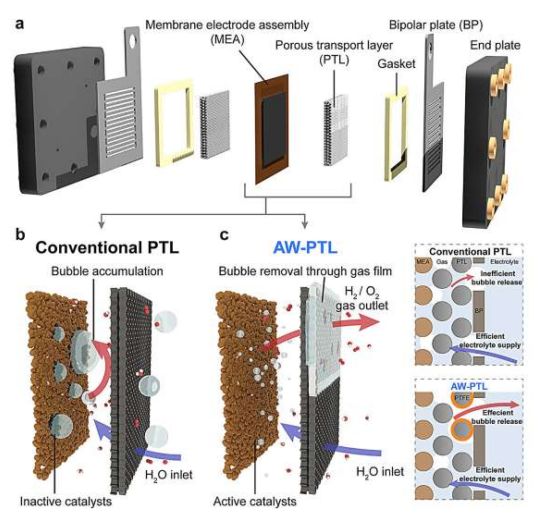
 

How the coating improves efficiency

Led by Professors Jungki Ryu and Dong Woog Lee from the School of Energy and Chemical Engineering at UNIST, the research team achieved a substantial performance improvement through a simple spray coating polytetrafluoroethylene (PTFE), widely known as Teflon, onto the porous transport layer (PTL), a vital component of water electrolyzers. The study is published in the journal Advanced Science and was chosen as a cover article.


Water electrolyzers produce hydrogen by splitting water molecules using electricity. During operation, hydrogen forms on the catalyst surface of the electrodes. However, when hydrogen bubbles stick to the catalyst, they block active sites and hinder the reaction, leading to reduced efficiency due to a decrease in accessible catalyst surface area.


To address this, the team coated the PTL—a component that helps transport hydrogen and water—with PTFE. Commonly used to make non-stick cookware, PTFE was applied via a simple spray coating. This coating prevents hydrogen bubbles from adhering to the porous structure, allowing them to escape easily and keeping the reaction running smoothly.


Design choices and practical results

Importantly, the researchers coated only the top half of the PTL, leaving the bottom part uncoated. Since the PTL also supplies water to the catalyst, limiting the coating to the top part ensures water flow remains unobstructed while hydrogen bubbles are efficiently expelled through the coated section. This design maintains water supply and enhances hydrogen removal simultaneously.


The results were remarkable, as the electrolysis cells with the coated PTL exhibited a 40% increase in current density compared to uncoated cells, thereby indicating higher hydrogen production rates. Additionally, the voltage increase typically caused by hydrogen bubble buildup was notably reduced, further boosting overall efficiency.


The coating process is simple and scalable, involving just spray application followed by heat treatment—no complex nanofabrication or elaborate manufacturing steps are required. The team successfully demonstrated coating large-area PTLs up to 225 cm², proving its practicality for real-world applications.


Professor Ryu commented,

While it is generally believed that increasing the hydrophilicity of the PTL improves water supply and efficiency, our findings show that a hydrophobic PTFE coating can actually enhance hydrogen removal and overall performance.


Professor Lee added,

Teflon is a well-known and widely available material, making this approach easy to adopt.


”Since the existing electrolysis systems remain unchanged, applying this coating is straightforward. Beyond water electrolysis, this method could also benefit other electrochemical systems that involve gas evolution, such as fuel cells and metal-air batteries.”


Source:   Hydrogencentral
Posted by Morning lark
, |

New review maps how nickel catalysts could unlock cheaper hydrogen fuel cells

Newswise — Hydrogen fuel cells generate electrical energy with only water as a by-product, making them central to future net-zero energy systems. Traditional proton-exchange membrane fuel cells rely on platinum catalysts, which raises cost and durability barriers. Alkaline anion-exchange membrane fuel cells (AEMFCs) enable the use of cheaper non-noble catalysts, yet hydrogen oxidation reaction (HOR) kinetics in alkaline media are two to three orders of magnitude slower than in acidic conditions, limiting performance. Nickel, abundant and electronically similar to platinum, is considered the most attractive alternative, but suffers from strong hydrogen binding and surface oxidation. Based on these challenges, further mechanistic insight and material design strategies are needed to advance Ni-based HOR catalysts. 

Researchers from Huazhong University of Science and Technology and collaborating institutions published a comprehensive review (DOI: 10.1016/j.esci.2025.100400) in eScience on September, 2025, summarizing breakthroughs in Ni-based non-noble metal electrocatalysts for alkaline HOR. The review integrates catalytic mechanism theories, performance evaluation criteria, and structural design strategies, proposing an element navigation map for material development. By comparing reported catalysts, testing protocols, and activity benchmarks, the authors outline how rational design can accelerate nickel-based catalysts toward real fuel-cell deployment.

The review first dissects reaction pathways involving Tafel, Volmer, and Heyrovsky steps, explaining how hydrogen binding energy (HBE) and hydroxide binding energy (OHBE) control catalytic speed. It further evaluates new theories including apparent HBE, bifunctional OH-adsorption mechanisms, potential-of-zero-charge effects, alkali-cation 2B theory, and hydrogen-bond network connectivity, emphasizing that no single model yet fully captures HOR behavior.

A rigorous protocol for electrochemical performance assessment is proposed, addressing reliability issues caused by Ni oxidation during measurement. Parameters including kinetic current density, exchange current density, electrochemical surface area, mass activity, peak power density, CO tolerance and durability are standardized for fair comparison. The article compiles one of the most complete datasets of HOR performance among Ni alloys, nitrides, borides, oxides, core–shell structures, doped nanomaterials and hybrid supports.

Development highlights include NiCu alloys, MoNi₄ catalysts with optimized HBE/OHBE, Ni₃N nanoparticles, ternary Ni–Mo–Nb metallic glass, and multi-alloys incorporating Fe/Co/W/Cu for electronic modulation. Certain systems approach or even surpass platinum in alkaline HOR mass activity, while maintaining strong resistance to CO poisoning and structural degradation.

The authors note,

We now understand that nickel is not just a cheaper substitute, but a tunable catalytic platform,

“By combining mechanistic theory with structural design, we can tailor hydrogen and hydroxyl adsorption, stabilize surfaces under alkaline conditions, and guide rational catalyst screening.” They emphasize that future research should integrate in-situ spectroscopy, advanced computational simulations, and standardized performance protocols, accelerating the translation of laboratory catalysts into real fuel-cell devices.

Ni-based catalysts offer a realistic path to low-cost hydrogen technologies, particularly where precious-metal catalysts hinder scale-up. The review’s roadmap could assist researchers in designing highly active HOR catalysts for AEMFC anodes, hydrogen purification systems, and next-generation energy storage. As activity and durability continue to improve through alloy engineering, defect modulation, and interface control, nickel materials may support commercial fuel-cell deployment in vehicles, distributed power and portable devices. The authors project that achieving stable long-term operation and meeting DOE targets could position Ni-based catalysts as a cornerstone of sustainable hydrogen energy.


New review maps how nickel catalysts could unlock cheaper hydrogen fuel cells - Hydrogen Central


New review maps how nickel catalysts could unlock cheaper hydrogen fuel cells - Hydrogen Central

New review maps how nickel catalysts could unlock cheaper hydrogen fuel cells Newswise — Hydrogen fuel cells generate electrical energy

hydrogen-central.com


Posted by Morning lark
, |

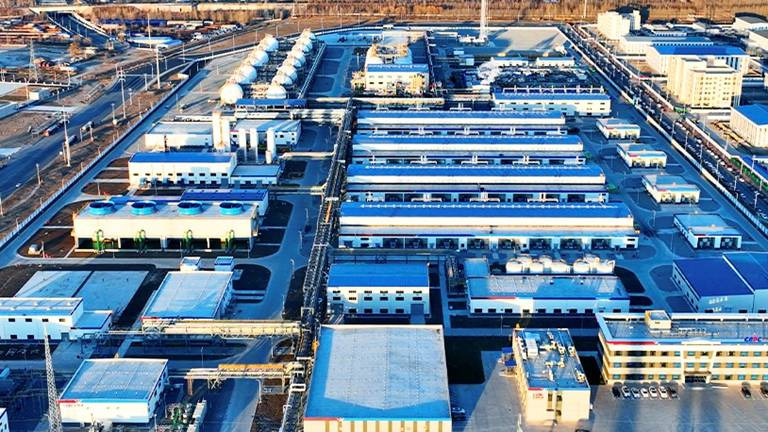
2025年12月18日、中国能源建設集団有限公司(China Energy Engineering Group :CEEC、北京市)と中国のSungrow Hydrogen(安徽省合肥市)が提携し、世界最大のグリーン水素・アンモニア・メタノール製造施設「清清1号プロジェクト」が稼働を開始し、第一期の試運転と第二期の着工が完了したと発表された。主要サプライヤーであるSungrow Hydrogenは、予定より早く水素製造システムを稼働させ、高純度の水素を安定的かつ信頼性の高い運転で供給している。

 このプロジェクトは段階的に開発され、再生可能エネルギー発電能力300万キロワット、グリーン合成アンモニアおよびメタノール年間生産量80万トンを目指している。このアプローチにより、グリーン電力の地産地消と高付加価値製品への転換が可能になる。また、清清1号プロジェクトは、プロジェクト全体規模、水素貯蔵容量、負荷フレキシブルプロセス範囲、アルカリ水電解水素製造設備の導入規模という4つの世界記録を樹立した。

 中核サプライヤーとして、Sungrow Hydrogenの柔軟なグリーン水素製造システムは、再生可能エネルギーの変動に効果的に対応し、システム効率を向上させる。複雑な動作条件下でも検証済みのこのシステムは、安定的かつ信頼性の高い運用を実現し、水素設備の標準化と拡張を強力にサポートするとともに、世界のグリーン水素産業に実用的なソリューションを提供する。

詳しくは、→https://www.sungrowpower.com/en/ceec-sungrow-hydrogen-partner-to-commission-world-largest-green-hydrogen-ammonia-methanol-project                                      

https://www.ceecgroup.cn/en/

Posted by Morning lark
, |

PipeChina Launches Feasibility Study for China's Largest Hydrogen-Ammonia-Methanol Pipeline: Chifeng-Jinzhou Project

In early November, PipeChina Group officially initiated the feasibility study for the Chifeng-Jinzhou Pipeline Project, marking a significant step toward creating China’s largest and longest multi-medium green energy coordination corridor.


PipeChina has established a dedicated project development team and begun research and coordination with cities across Liaoning Province for this landmark hydrogen energy pipeline.


The pipeline originates in Chifeng City, Inner Mongolia, and terminates at Jinzhou Port in Jinzhou City, Liaoning Province. Spanning 290 kilometers, the project utilizes a parallel laying scheme to transport hydrogen, methanol, and liquid ammonia. Since all these mediums are derived from green energy sources, the Chifeng-Jinzhou route will become China's first large-scale, multi-medium green energy corridor.


Strategic Context: Inner Mongolia's "One Main Line, Two Rings"


The Chifeng-Jinzhou project is central to a broader regional initiative. In March, Inner Mongolia Mengqing Pipeline Network Co., Ltd. launched a tender for preliminary work on key phases of the region’s massive green hydrogen and green fuel pipeline network.

The total tender covers a network of 14 pipelines, spanning 4,400 kilometers, including 10 green hydrogen lines, 3 green methanol lines, and 1 green ammonia line.


This tender is a crucial step by the Inner Mongolia Energy Group to realize the region’s "One Main Line, Two Rings, and Four Export Routes" transportation network. This strategic layout, proposed in November 2024, aims to fully open multiple green hydrogen export channels connecting Inner Mongolia with key consumption markets, including the Beijing-Tianjin-Hebei region, Shaanxi, Ningxia, and Liaoning.


The "One Main Line, Two Rings" framework establishes:


Two Rings: A western network surrounding Ordos City and an eastern network centered around Chifeng and Tongliao City.


One Main Line: A central artery connecting Ordos, Hohhot, Ulanqab, Xilingol League, and Chifeng, linking major green hydrogen production hubs, industrial parks, and consumption markets across the region.


Anchor Project: Linking to the World’s Largest Green Ammonia Plant


The Chifeng-Jinzhou Hydrogen Energy Pipeline is directly tied to the Envision Chifeng Project, recognized as the world’s largest green hydrogen-ammonia initiative.


Following the commissioning of the Envision project's first phase in early July, Jinzhou Vice Mayor Li Jinbing confirmed that governments and relevant national departments are actively advancing the feasibility study and construction of a new energy pipeline from Yuanbaoshan to Jinzhou Port. This pipeline is essential for leveraging Jinzhou Port to provide logistics, consumption, and transportation services for Envision’s massive production base in Chifeng.


The commissioned first phase of the Envision project features 1.43 million kilowatts of wind and photovoltaic power generation capacity, 680 megawatt-hours of energy storage, and an annual output of 320,000 tons of green synthetic ammonia. Full completion across all three phases is expected to bring the total annual capacity to 1.52 million tons.


PipeChina's Strategic Future


The official launch of the Chifeng-Jinzhou Project underscores PipeChina Group’s strategic entry into emerging clean energy industries. By focusing on the green hydrogen-based sector, PipeChina is proactively deploying research, building a technical system for integrated hydrogen-ammonia-methanol-carbon transportation, and actively planning for a "national integrated network" for green hydrogen-based energy transmission. In the northeast region, the company aims to establish a crucial energy export channel by utilizing existing oil product pipeline corridors.


Source:FuelCellChina

Posted by Morning lark
, |

On November 10, Shanhai Hydrogen (Shanghai) New Energy Technology Co., Ltd. ushered in an in-depth visit to the hydrogen energy business delegation of Bosch Group. The delegation was composed of core members of Bosch's procurement, product management and R&D teams, including Mr. Buekki Zoltan-Alfred, Mr. Froehlich Schlapp Michael, Ms. Lu Beiwen, Product Manager Mr. Marino Michael Giuseppe, and R&D expert Ms. Yan Yan。 The purpose of this visit was to conduct an in-depth examination of Shanhai Hydrogen's membrane electrode technical strength, and to conduct substantive discussions on CCM (Catalyst Coated Membrane) procurement strategies and future cooperation plans.


The Bosch procurement team elaborated on its CCM procurement strategy and global supply chain layout in the field of PEM electrolysis. In particular, the delegation expressed its high appreciation for China's continued policy support in the field of clean energy and hydrogen energy, and made it clear that it is optimistic about the huge potential of the Chinese market.


Product Manager Mr. Marino Michael Giuseppe, a PhD in the field of electrolysis of water, shared valuable technical insights based on his in-depth research on AEM membranes during his student days. He clearly pointed out: "PEM technology is more suitable for large-scale consumption of wind and solar fluctuating power than AEM. The service life of AEM membrane is still the biggest bottleneck in the industry, and even if the current target reaches 10,000 hours, it is still difficult to meet the needs of large-scale industrial applications. This professional judgment is highly consistent with Shanhai Hydrogen's strategic choice to focus on PEM technology route.


Through this in-depth exchange, the two sides reached a number of consensus on technology research and development, supply chain collaboration and market expansion. Shanhai Hydrogen's technology accumulation in the fields of large-size membrane electrodes and low-iridium catalysts strongly complements Bosch's advantages in system integration, global layout and quality management.


Based on this fruitful exchange, Shanhai Hydrogen officially entered the Bosch CCM core supplier inspection list, and the two sides agreed to carry out follow-up in-depth cooperation on specific technical specifications, quality standards and supply plans. During the critical period of global energy transition, this visit has laid a solid foundation for in-depth cooperation between the two sides in the field of green hydrogen in the future, demonstrating the firm determination of Chinese and foreign enterprises to work together to promote energy transformation.

Posted by Morning lark
, |