블로그 이미지
Morning lark

카테고리

분류 전체보기 (2262)
Fuel Cell (898)
New Energy (1211)
Energy Storage (6)
New Biz Item (2)
Total
Today
Yesterday

Automotive major General Motors (GM) will halt development of its next-generation hydrogen fuel cells.

In an attempt to “sharpen its focus on technologies that show the clearest path to scale and customer value,” GM and its partner Honda have ended production and reportedly scrapped plans to construct a $55m plant in Detroit.

Instead of advancing the development of its Hydrotec brand, GM will concentrate R&D and capital resources on batteries, charging technologies, and electric vehicles (EVs).

“[These] have clear market traction, rather than on hydrogen, which has yet to fulfil its potential,” the firm said in a statement.

However, through the joint venture (JV) Fuel Cell System Manufacturing LLC, GM will continue to produce hydrogen fuel cells for data centres and power generation at its Michigan plant.

FCSM’s 70,000 sq ft facility in Brownstown was established in 2017 through an $86m joint investment, producing hydrogen power solutions for both companies.

Although large-scale hydrogen fuel cell manufacturing began in Michigan last year, recent reporting suggests that GM has laid off employees, while construction of its planned Hydrotec facility in Detroit has also been halted.

GM attributed the decision to broader market challenges and noted that “hydrogen holds promise for specific high-demand industrial applications like backup power, mining, and heavy trucking.”

But it added, “The path to reaching a sustainable business in fuel cells is long and uncertain. High costs and limited hydrogen infrastructure in the US have limited consumer adoption of fuel cell-powered vehicles.

“According to the US Department of Energy (DOE), only 61 hydrogen refuelling stations exist nationwide, compared to more than 250,000 level two or faster electric vehicle charging locations.”

GM has invested heavily in hydrogen fuel cell development, allocating $35 million in 2021 to expand production across multiple plants and projects. Its decision to scale back production comes amid growing uncertainty in the US hydrogen industry.

Reports emerged last week that the DOE is planning to cancel grants for all five of the remaining federally backed hydrogen hubs.

While GM is pulling back from hydrogen fuel cell R&D and pausing Hydrotec development, partner Honda is pushing forward independently with its own fuel cell development.

Last February, Honda said it costs half as much to produce and is more than twice as durable as the current model.

Posted by Morning lark
, |

With the rise of renewable energy and electric vehicles, hydrogen-powered vehicles have attracted growing interest. Prof. Molly Mengjung Li, Assistant Professor of the Department of Applied Physics at The Hong Kong Polytechnic University is dedicated to researching ammonia as a hydrogen carrier and has recently developed a highly efficient, low-cost catalyst, helping to advance the practical adoption of hydrogen vehicles.

The global transition towards sustainable energy has placed hydrogen-powered vehicles at the forefront of clean transportation solutions. As governments and industries strive to decarbonise mobility, the acceptance of hydrogen fuel cell vehicles is gaining momentum due to their high energy efficiency and zero-emission credentials. However, the widespread adoption of hydrogen energy vehicles hinges not only on the development of fuel cell technology but also on the safe, efficient, and cost-effective storage and release of hydrogen itself.

Prof. Li, and her research team are investigating the possibility of using ammonia as a hydrogen fuel carrier and studying the stability of hydrogen energy storage in order to promote the popularisation of hydrogen-powered vehicles. Their study, published in Advanced Materials, introduces an efficient and cheap catalyst to facilitate the hydrogen energy generation reaction.

Hydrogen (H2), when used in fuel cells, reacts with oxygen (O2) to generate electricity, emitting only water (H2O) as a by-product. This reaction offers a compelling alternative to fossil fuel combustion, promising both environmental and operational advantages. However, hydrogen’s low volumetric density and the challenges associated with its storage and transport have long been recognised as significant barriers to its practical deployment. Among the various strategies proposed, chemical carriers such as ammonia (NH3) have emerged as promising solutions. NH3 boasts a well-established production and distribution infrastructure, a high hydrogen density and the ability to release hydrogen without generating carbon oxides. The decomposition of NH3 into N2 and H2 is thus a critical reaction for on-board hydrogen generation in fuel cell vehicles.

Despite its promise, the practical implementation of NH3 cracking technology faces a major hurdle—the reliance on ruthenium (Ru)-based catalysts. Ru catalysts are highly effective for low-temperature NH3 decomposition but their scarcity and high cost impede large-scale adoption. This has spurred a global research effort to identify alternative catalysts based on earth-abundant, non-noble metals.

Cobalt (Co) has emerged as a particularly attractive candidate, given its favourable nitrogen binding energy and lower susceptibility to catalyst poisoning compared to other transition metals. However, conventional Co-based catalysts typically require high temperatures (>600°C) to achieve satisfactory hydrogen yields, limiting their utility for mobile applications where energy efficiency and compact reactor design are paramount considerations.

To address these challenges, recent research has focused on innovative catalyst design strategies that can enhance the low-temperature activity of Co-based systems. One such approach is the engineering of lattice strain at the catalyst-support interface, which can modulate the electronic structure of active sites and thereby optimise their interaction with reactants. Drawing inspiration from advances in strain engineering in other catalytic systems, Prof. Li’s research team has developed a new class of core@shell catalysts, exemplified by the Co@BaAl₂O₄₋ₓ heterostructure.

Performance testing of the Co@BaAl₂O₄₋ₓ catalyst reveals remarkable activity for NH3 decomposition at moderate temperatures. Under high space velocity conditions, the catalyst achieves a hydrogen production rate of 64.6 mmol H₂ gcat-1 min-1 and maintains nearly complete NH3 conversion between 475°C and 575°C. These results are on par with, or even surpass, those of many Ru-based catalysts, but without the associated cost and supply constraints. Advanced characterisation techniques, including synchrotron X-ray absorption spectroscopy and electron microscopy, confirm the formation of a well-defined core@shell structure and the presence of nitrogen species at the interface after reaction, highlighting the critical role of the heterostructure in facilitating the catalytic process.

To further elucidate the advantages of the core@shell design, a comparative study was conducted with a conventional supported catalyst, Co/BaAl₂O₄₋ₓ, which lacks the encapsulating shell. Both catalysts were prepared with similar cobalt nanoparticle sizes to ensure a fair comparison. The results are striking: while both systems exhibit increasing NH3 conversion with temperature, the core@shell Co@BaAl₂O₄₋ₓ catalyst demonstrates a significantly lower onset temperature for activity (200°C versus 250°C) and achieves near-complete conversion at 500°C, compared to even higher temperature for the supported analogue. Moreover, the core@shell structure exhibits superior stability under high flow rates, whereas the supported catalyst suffers from a sharp decline in performance.

The development of the Co@BaAl2O4-x core@shell catalyst represents a significant advance in the quest for efficient, Ru-free catalysts for ammonia cracking in hydrogen energy vehicles. By leveraging lattice strain engineering and strong metal-support interactions, this system achieves low-temperature activity and stability previously attainable only with precious metals. The mechanistic insights gained from this work not only inform the design of next-generation catalysts for clean energy applications but also underscore the transformative potential of interface engineering in heterogeneous catalysis. As the hydrogen economy continues to evolve, such innovations will be pivotal in realising the full potential of hydrogen as a sustainable fuel for the future of mobility.

Source: Innovation Digest


Efficient Cobalt Catalysts Boost Hydrogen Fuel Cell Vehicles - Fuelcellsworks

Researchers develop advanced cobalt-based catalysts to improve hydrogen storage and release, making hydrogen fuel cell vehicles more practical and cost-effective.

fuelcellsworks.com


Posted by Morning lark
, |

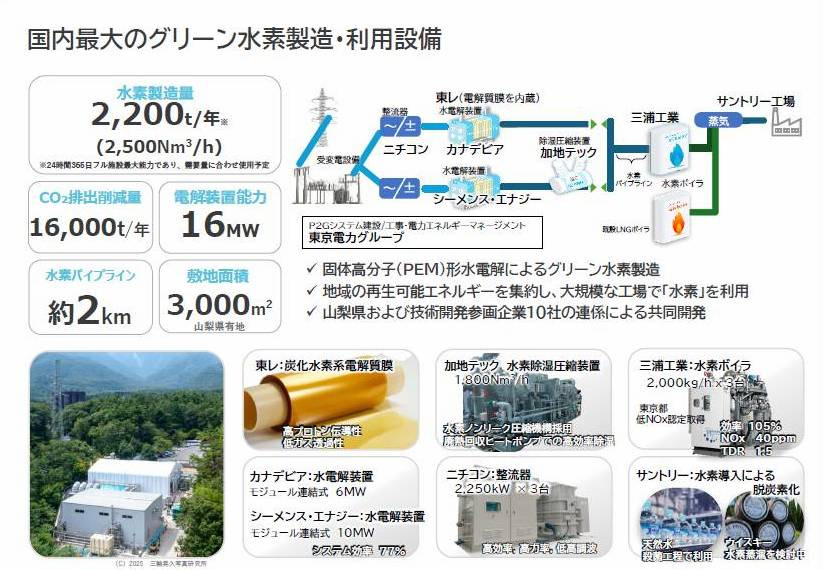
2025年10月11日、山梨県、並びに技術開発参画企業 10 社(東レ㈱、東京電力ホールディングス㈱、東京電力エナジーパートナー㈱、カナデビア㈱、シーメンス・エナジー㈱、㈱加地テック、三浦工業㈱、サントリーホールディングス㈱、ニチコン㈱、㈱やまなしハイドロジェンカンパニー(YHC))は、国立研究開発法人新エネルギー・産業技術総合開発機構(NEDO)のグリーンイノベーション基金事業による助成を受け、サントリー天然水 南アルプス白州工場(山梨県北杜市)、及びサントリー白州蒸溜所(山梨県北杜市)の脱炭素化に向けた「カーボンニュートラル実現へ向けた大規模P2Gシステムによるエネルギー需要転換・利用技術開発」に係る実証として、11日からグリーン水素の製造及び、天然水工場での利用を開始した。

 今回、設置するグリーン水素製造設備の能力は 16MW と日本最大であり、24 時間 365 日稼働した場合、年間 2,200トンの水素を製造し、16,000トンの CO2排出量の削減が可能だ。利用面では、高効率かつ低 NOXの水素ボイラを開発し、天然水工場で使う熱源の一部を化石燃料(天然ガス)から水素に転換する実証を進めていく。併せて、天然水工場及び蒸溜所の脱炭素化とともに、周辺地域での水素の活用拡大を推進していく。

 今後、2026 年末までの期間で再生可能エネルギー由来の電力の調達からグリーン水素での蒸気製造に至る一連のシステムを実証することにより、将来の再生可能エネルギーの大量導入に併せ、様々な地域や場所への当該システムの展開を目指していく。
 また、自然豊かな北杜市白州で、本システムがグリーン水素の供給ハブとなり、将来的に多くの方に親しまれることを目指し、実証地を「グリーン水素パーク -白州-」と命名した。山梨県並びに技術開発参画企業10社は引き続き密に連携し、カーボンニュートラル社会の実現に向け、固体高分子(PEM)形水電解によるグリーン水素製造の技術開発に加え、水素エネルギーの需要拡大へ積極的に取り組んでいく考えだ。

詳しくは、→https://www.pref.yamanashi.jp/documents/99077/r061011_release.pdf

https://www.suntory.co.jp/news/article/14915.html


サントリー天然水 南アルプス白州工場及びサントリー白州蒸溜所へのグリーン水素導入に向け

サントリー天然水 南アルプス白州工場及びサントリー白州蒸溜所へのグリーン水素導入に向けた日本最大のP2Gシステムによるエネルギー需要転換実証を開始。

www.suntory.co.jp


Posted by Morning lark
, |